






Manufacturing Process

Q195 Steel Chemical Composition
|
Element |
Composition (%) (Max) |
Typical Range |
Notes |
|
Carbon (C) |
≤0.12% |
0.06–0.12% |
Low carbon ensures good weldability/formability |
|
Manganese (Mn) |
≤0.50% |
0.25–0.50% |
Improves strength without sacrificing ductility |
|
Silicon (Si) |
≤0.30% |
0.10–0.30% |
Deoxidizer, minor impact on properties |
|
Phosphorus (P) |
≤0.045% |
≤0.040% |
Controlled to avoid brittleness |
|
Sulfur (S) |
≤0.050% |
≤0.040% |
Minimized to prevent hot cracking |
|
Iron (Fe) |
Balance |
~99% |
Primary constituent |
Common Sizes
|
Parameter |
Options |
|
Thickness |
0.3mm – 1.2mm (common: 0.45–0.75mm) |
|
Width |
750mm, 820mm, 1000mm (custom up to 1250mm) |
|
Length |
2m – 12m (customizable) |
|
Profile |
Trapezoidal, sinusoidal, tile-pattern |
|
Coating |
HDG, PPGI, PVC |
Surface treatment

Advantage of Q195 Roofing Sheet
|
Advantage |
Specific Benefits |
|
Cost Efficiency |
▪ Lower material cost (10-15% cheaper than Q235) |
|
Workability |
▪ Cold-formed into complex corrugations (min. bend radius = thickness×15) |
|
Lightweight |
▪ 1/10 the weight of concrete roofs |
|
Corrosion Resistance |
▪ Zinc coating (60g/m²) withstands ≥500h salt spray |
|
Installation Speed |
▪ 5x faster installation than traditional tiles |
|
Thermal Performance |
▪ ≥70% solar reflectance (light colors) |
|
Eco-Friendliness |
▪ 100% recyclable |
|
Low Maintenance |
▪ Damaged sections replaceable |
Application
|
Application Area |
Examples |
|
Industrial Buildings |
Factories producing machinery, electronics, textiles, etc. |
|
Warehouses |
General - purpose, food, raw material warehouses |
|
Agricultural Buildings |
Barns, sheds, greenhouses for livestock, equipment, crops (e.g., chicken coops, vegetable greenhouses) |
|
Low - Rise Residential Buildings |
Single - story houses, add - on structures, especially in rural areas |
|
Temporary Buildings |
Construction site offices, temporary shelters, exhibition booths |
Packing
|
Type |
Description |
Best For |
Load Capacity |
|
Flat Bundles |
Sheets stacked horizontally with edge protectors, strapped with steel/PET bands |
Factory transport, short-distance |
≤2 tons per bundle |
|
Vertical Crates |
Sheets stood on edge in wooden frames, separated by foam spacers |
Export(prevent deformation) |
1-1.5 tons per crate |
|
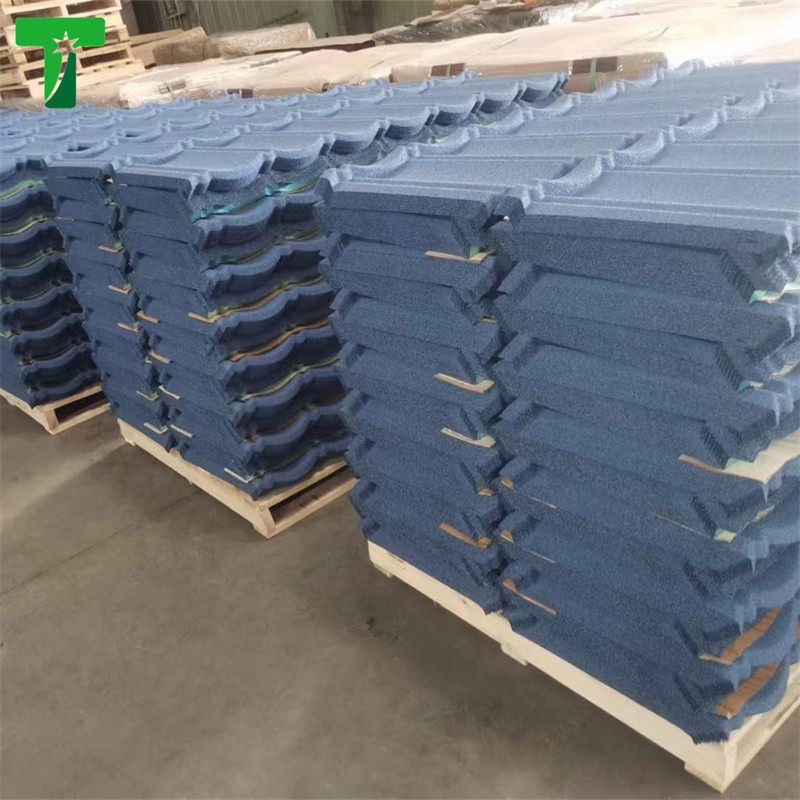
Palletized |
Stacked on ISO-standard pallets (1200×800mm), shrink-wrapped with corner guards |
Forklift handling, warehouse storage |
≤1 ton per pallet |
|
Roll Packing |
Flexible roofing (e.g., aluminum underlay) rolled around cardboard cores |
Long coiled sheets |
≤800kg per roll |


FAQ
Q: What are the material characteristics of Q195 Roofing Sheet?
A:
Q195 Roofing Sheet is based on Q195 low-carbon steel, which has a low carbon content, giving it good plasticity and weldability. Its yield strength reaches 195MPa, which can meet the strength requirements of most conventional building scenes.
Q: What is the difference between Q195 and Q235 corrugated board?
A:
Q195: Lower cost (10-15% cheaper), slightly weaker in strength (yield strength ≥ 195MPa), suitable for non-harsh environments.
Q235: Higher in strength (yield strength ≥ 235MPa), used in heavy snow/typhoon areas.
Q:How long is the service life?
A:Under normal use and proper maintenance, the service life of Q195 color corrugated board can reach 15-20 years. In areas with mild environment and no frequent severe weather, it may be longer.
Q: Is it environmentally friendly? Can it be recycled?
A: It is 100% recyclable, and the production energy consumption is 70% lower than that of concrete tiles, meeting green building standards.
Q: What are the common thicknesses? How to choose?
A:
0.3-0.5mm: temporary buildings/farm sheds.
0.6-0.8mm: factories/warehouses (recommended).
≥1.0mm: rarely used
Hot Tags: q195 roofing sheet, China q195 roofing sheet suppliers, carbon steel for industries, carbon steel plate and coil, carbon steel for tower, low carbon steel sheet, carbon steel for rims, carbon steel for covers


